
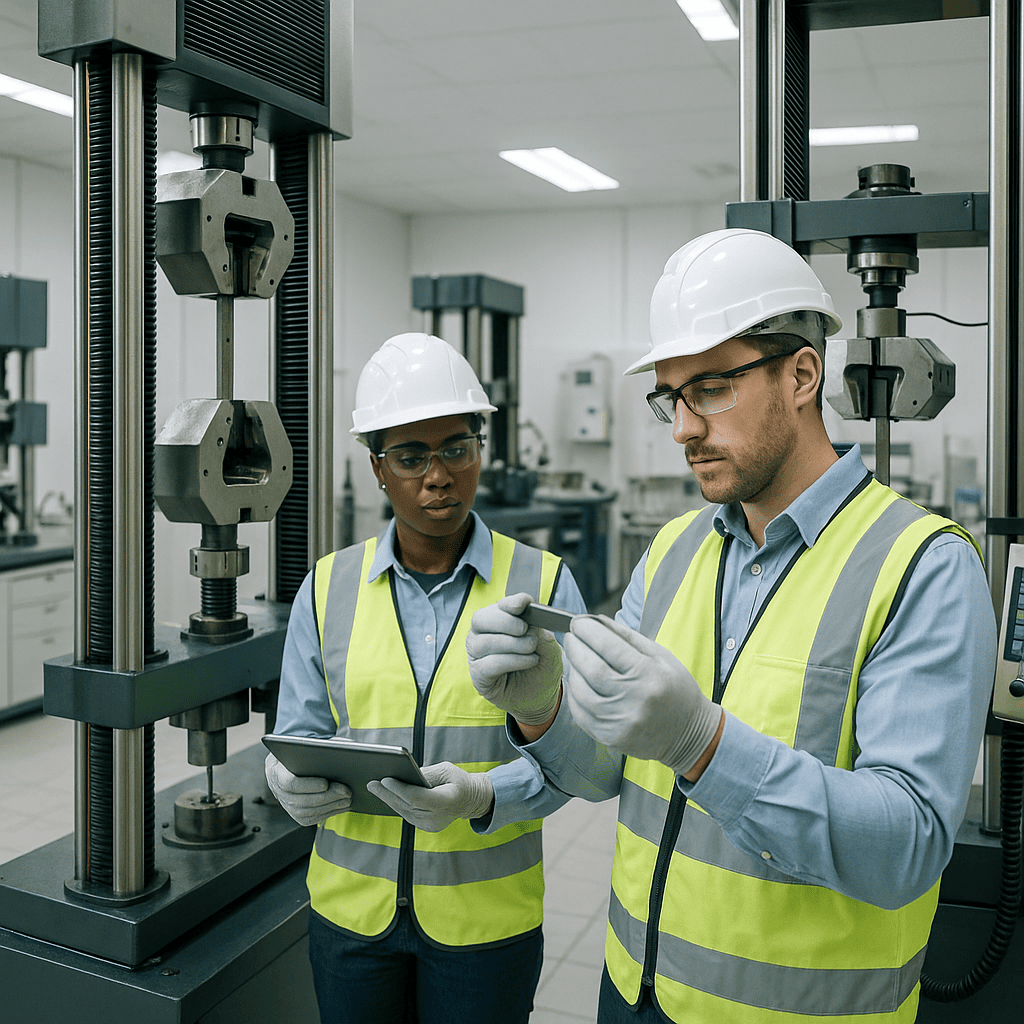
Material testing services play a foundational role in construction, manufacturing, engineering, and product development. Whether it’s a steel beam used in a skyscraper, concrete poured into a bridge, or polymers used in medical equipment, every material must undergo rigorous testing to verify its strength, durability, and reliability. The purpose of material testing is simple: to ensure the product performs safely and efficiently in real-world conditions. As industries innovate and the demand for quality-driven infrastructure grows, material testing has become an essential part of global quality assurance systems. This article explores what material testing services include, why they matter, how they are conducted, and the industries that depend heavily on them.
What Are Material Testing Services?
Material testing services involve examining and evaluating the physical, chemical, and mechanical properties of materials to determine if they meet specific standards. These tests reveal how materials behave under stress, temperature changes, impact, bending, load, wear, corrosion, and environmental exposure. The ultimate goal is to verify quality, performance, safety, and compliance with national and international standards such as ASTM, BIS, ISO, DIN, and EN.
Why Material Testing Matters
Every engineering failure, whether a cracked bridge, broken machine component, or faulty industrial product, can result in financial loss, downtime, and risk to human life. Material testing reduces these risks by identifying weaknesses before damages occur.
Key reasons material testing is important:
- Ensures product quality & reliability
- Prevents accidents, breakage & structural collapse
- Helps engineers select the right material for specific applications
- Increases lifespan and durability of components
- Guarantees compliance with legal and safety standards
-
Saves cost by preventing failures after installation
In industries where safety is non-negotiable, material testing is not just a requirement; it is a responsibility.
Types of Material Testing Services
Material testing can be classified into two major categories: Destructive Testing (DT) & Non-Destructive Testing (NDT).
🔹 1. Destructive Testing (DT)
In destructive testing, a material sample is subjected to extreme conditions until it breaks or deforms. Although the sample is damaged, the test provides valuable insight into maximum load capacity and failure conditions.
Common destructive tests include:
| Test Type | Purpose |
|---|---|
| Tensile Test | Measures ultimate strength and elongation |
| Compression Test | Determines resistance under load |
| Bend/Flexural Test | Tests ductility and flexibility |
| Impact Test (Charpy/Izod) | Checks shock resistance |
| Hardness Test | Measures resistance to deformation |
| Fatigue Testing | Determines endurance under repetitive stress |
Destructive testing is widely used in metal fabrication, manufacturing, construction, and automotive design.
🔹 2. Non-Destructive Testing (NDT)
Non-destructive testing evaluates material quality without causing damage. This method is ideal for detecting flaws, cracks, and corrosion within completed components or structures.
Popular NDT methods include:
| Test Type | Description |
|---|---|
| Ultrasonic Testing (UT) | Detects internal flaws using sound waves |
| Radiographic Testing (RT) | Uses X-rays or Gamma rays for defect imaging |
| Magnetic Particle Testing (MPI) | Finds surface cracks in ferromagnetic materials |
| Dye Penetrant Testing (DPT) | Detects surface-level cracks using color contrast |
| Eddy Current Testing | Tests conductivity & surface defects |
| Visual Inspection (VT) | Simple but essential quality check |
NDT is crucial in aerospace, oil & gas, power plants, pipeline inspections, and heavy machinery.
Material Testing Laboratories & Equipment
Material testing laboratories are equipped with advanced machinery, calibrated instruments, climate-controlled chambers, and certified experts to perform detailed analysis. Some commonly used laboratory equipment includes:
- Universal Testing Machine (UTM)
- Hardness Tester (Rockwell, Brinell, Vickers)
- Impact Testing Machine
- Spectrometer for chemical composition
- Metallurgical microscope
- Corrosion testing chambers
- Ultrasonic & radiography scanners
-
Fatigue & creep testing machines
With automated systems and digital reporting, modern labs ensure precise and traceable results.
Industries That Depend on Material Testing
Almost every industry that involves physical products or infrastructure needs material testing. The most prominent sectors include:
🏗 Construction & Civil Engineering
Cement, concrete blocks, rebar, steel beams, and aggregates must be tested for load-bearing capacity to avoid structural failure.
🚗 Automotive & Manufacturing
Vehicle chassis, engines, gears, and components undergo fatigue, vibration, and tensile tests for durability.
✈ Aerospace & Defense
Aircraft materials are exposed to extreme pressure and temperature changes. Testing ensures extraordinary reliability.
🏭 Oil & Gas, Petrochemicals
Pipelines, pressure vessels, and refinery equipment must resist corrosion and high pressure for long-term operation.
⚡ Power & Energy
Thermal, hydro, nuclear, and solar infrastructure requires strong material performance over the years of usage.
📦 Consumer Goods & Electronics
Plastic, polymer, and metal parts in daily-use appliances are tested for quality and safety.
Benefits of Material Testing for Businesses
For industries, material testing is not just a quality-check step; it is a business advantage. Companies that invest in testing services experience:
✔ Higher product life and reliability
✔ Increased customer trust and brand reputation
✔ Fewer project failures and maintenance issues
✔ Compliance with international standards
✔ Faster approval for tenders and certifications
✔ Better R&D and material innovation
In competitive markets, quality is a differentiator, and material testing makes quality measurable.
Future Trends in Material Testing
As industries grow, testing technologies continue to evolve. The future of material testing will be influenced by:
- AI-integrated defect detection
- Automated robotic testing systems
- Real-time structural monitoring using IoT
- Simulation-based material analysis
- Eco-friendly material durability studies
- Nanomaterial mechanical behavior testing
The vision is clear: more accuracy, less failure, zero compromise.
Conclusion
Material testing services form the backbone of safe, reliable, and efficient engineering worldwide. From skyscrapers to spacecraft and highways to household machines, everything begins with the right material, and every right material must be tested. Through advanced laboratories, scientific procedures, and certified testing methods, industries can ensure durability, performance, and confidence in the structures we depend on every day.
Material testing is not just a process; it is the science behind strength.
